Looking Ahead to a Busy 2026
- Share
-

-

-

-

All people, no matter who they are or where they live, deserve access to evidence-based treatment. That’s why the National Council for Mental Wellbeing continues working to eliminate barriers to care. As we ring in the new year, I’d like to tell you about some of the policy areas we’re resolving to focus on in 2026.
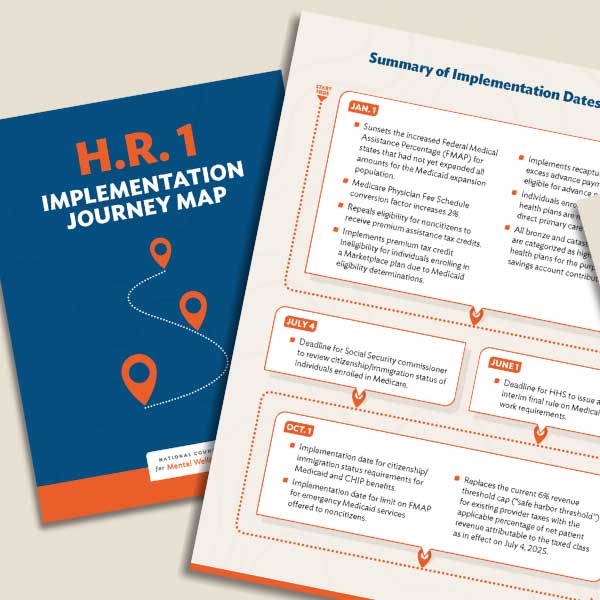
The One Big Beautiful Bill Act (H.R.1) places new restrictions on Medicaid to help offset the cost of the bill’s tax cuts and other spending items. This will result in significant Medicaid funding reductions. In many cases, the reductions will be phased in over the next several years, but we need to prepare for those changes now. We’ve created an H.R.1 Implementation Journey Map that includes clear, actionable information and guidance on the policy changes ahead, the roles of key stakeholders and the opportunities for engagement that matter most.
In the year ahead, we will provide more implementation guidance for key provisions impacting Medicaid, including:
- Work/community engagement requirements
- Cost-sharing requirements
- Restrictions on provider tax arrangements and state-directed payments
- Address verification
- More frequent eligibility redeterminations for certain enrollees
These Medicaid funding reductions and eligibility restrictions could create more barriers to accessing care and lead to difficult financial circumstances for providers and the states in which they operate.
While H.R. 1 will present many new challenges, it may also present us with opportunities. For instance, it contains certain exemptions that recognize the value of community-based providers. Specifically, all services provided at Certified Community Behavioral Health Clinics (CCBHCs) are exempt from the bill’s cost-sharing requirements for patients. In addition, CCBHCs, Community Mental Health Centers (CMHCs) and Opioid Treatment Programs are among the provider types eligible for relief funding through the Rural Health Transformation Program.
In addition to H.R. 1, we’re focused on the Ensuring Excellence in Mental Health Act (S.3402), which was introduced by bipartisan champions Sens. John Cornyn, R-Tex.; Tina Smith, D-Minn.; Thom Tillis, R-N.C.; and Catherine Cortez Masto, D-Nev., on Dec. 9. Among other provisions, the bill would:
- Establish the CCBHC prospective payment system as a sustainable option for states implementing the model under the state Medicaid option. This allows states to expand the availability of evidence-based services, increase their workforce and integrate services with other providers in their communities.
- Advance care integration by enabling CCBHCs to provide additional services, including primary care.
- Establish CCBHCs as a provider type with prospective payment in Medicare, strengthening their ability to serve older adults.
We’re also advocating for several other bipartisan bills that would improve access to critical prevention, treatment and recovery services and bolster the workforce, as well as bills that would give local officials tools to reduce recidivism and help formerly incarcerated people return to work and family life in their communities:
- The Due Process Continuity of Care Act (H.R.1510/S.1720) would permit Medicaid payment for medical services furnished to individuals held in custody prior to adjudication (i.e., those who have not been tried or convicted of a crime).
- The Reentry Act of 2025 (H.R.2586) would allow Medicaid payment for medical services furnished to an incarcerated person during the 30-day period preceding their release.
- The Providing Empathetic and Effective Recovery (PEER) Support Act (H.R.2741/S.1329) would remove obstacles and make it easier for people to become credentialed peer support specialists.
- The Promoting Effective and Empowering Recovery Services (PEERS) in Medicare Act (H.R.6841/S.3521) would allow Medicare to include peer support specialists as part of interdisciplinary integrated care teams. It would also help to expand access to peers in several different settings, including CCBHCs, CMHCs, Federally Qualified Health Centers and Rural Health Clinics.
- The Community Mental Wellness Worker Training Act (H.R.5733) would create a grant program to allow CCBHCs, CMHCs, hospitals and other behavioral health organizations to train mental wellness workers, increasing resources for the community.
While we live in an ever-changing world, it’s worth remembering that some things shouldn’t change: All people deserve access to evidence-based treatment, no matter who they are or where they live. This is what motivates us to keep doing the work.
Looking at the year that lies in front of us, we know this work is possible with the support that exists on both sides of the aisle. The first Trump administration expanded the CCBHC Demonstration, adding two new states. In 2022, Sen. Cornyn and Sen. Chris Murphy, D-Conn., spearheaded passage of the Bipartisan Safer Communities Act (sponsored by former Sen. Marco Rubio, R-Fla.), which provided the best opportunity in decades to eliminate barriers to accessing care.
Powerful efforts have gone toward supporting those with mental health and substance use challenges, but we have much more to work to do in the new year. Please let your lawmakers know that these priorities matter to you. You can use this link to send a note directly to your lawmakers with a prewritten, editable message urging them to support many of these critical policy efforts.