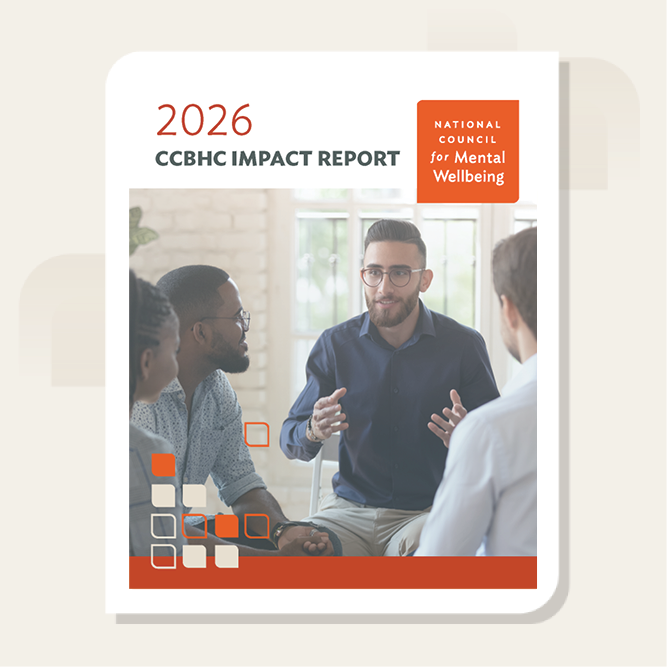
2026 CCBHC Impact Report
- Share
-

-

-

-

The Certified Community Behavioral Health Clinic (CCBHC) model is delivering the resources our nation needs to transform mental health and substance use care so our communities can thrive.
What Is a CCBHC?
CCBHCs are clinics — either recipients of a federal CCBHC grant or certified by their states as CCBHCs within Medicaid — that receive flexible funding to support their costs of expanding the scope of mental health and substance use care and serving new people in their community. They incorporate evidence-based practices and establish care coordination as a central part of service delivery to meet their community’s needs. They are required to serve anyone with a need for behavioral health care, regardless of age, ability to pay or place of residence.
New Data Shows CCBHCs Are Improving Wellbeing
3.4 million
people served by all CCBHCs in the U.S.
1/2
of CCBHC clients with opioid use disorder receive medication-assisted treatment, nearly three times the national average.
73%
of CCBHCs provide services on-site in one or more schools.
98%
of CCBHCs are actively engaged in one or more innovative activities in partnership with criminal justice entities, resulting in improved diversion from arrest to treatment and reduced law enforcement time for behavioral health crises.
94%
of CCBHCs have partnerships with housing entities to address homelessness.
65%
of CCBHCs provide employment support to increase hiring, work readiness and job retention.
1/2
of CCBHCs are making comprehensive primary care available on-site.
32,086
new staff positions were hired by CCBHCs (median of 31 new positions per clinic).
“CCBHC grant funding has allowed our clinic to care for clients with a holistic lens, as we are able to provide services through a multitude of different access points such as: primary care services, reentry services, mental health treatment court, and juvenile justice.”
— The Guidance Center, Arkansas (CCBHC-E grantee)
“Recently, our CCBHC has expanded partnerships with Boys & Girls Clubs across Marion County and has also developed new collaborations with virtual education programs. These efforts help us reach youth in environments where they already learn, gather and build relationships, allowing us to provide earlier intervention and more accessible behavioral health support.”
— Adult and Child Health Inc., Indiana (Medicaid CCBHC)
“Community partners have shared that they are ‘blown away’ that a referred patient was able to be seen the very next day. Some patients and their families shared that they had been unable to find behavioral health care elsewhere for years, and were emotional and relieved to finally be seen.”
— CHAS Health, Washington (CCBHC-E grantee)
“AltaPointe expanded training for law enforcement across our seven-county region, using virtual reality simulation technology that allows officers to practice responding to behavioral health crises in realistic scenarios. Tablet devices placed in patrol vehicles allow officers to connect individuals directly with a clinician through 24/7 telehealth consultation. As these partnerships and tools have expanded, Crisis Center utilization has increased while arrests related to behavioral health crises have declined. Law enforcement agencies also report significant reductions in use-of-force incidents and officer injuries during behavioral health calls, while the presence of clinicians during high-risk situations has helped reduce fatal outcomes.”
— AltaPointe Health, Alabama (Medicaid CCBHC)
Learn More About CCBHCs
- Check out the National Council’s CCBHC Success Center.
- Learn how we can strengthen CCBHCs through the Ensuring Excellence in Mental Health Act.
- Contact Congress in support of S.3402/H.R.8487, legislation to expand and sustain CCBHCs nationwide.
- Learn about how voters across the political spectrum overwhelmingly support expanding federal and state funding for CCBHCs.
- Contact our Policy & Advocacy team for further guidance on effectively using this new data in advocacy efforts.
- Visit the CCBHC-E National Training and Technical Assistance Center for resources related to certification, sustainability and implementation of evidence-based practices.
- Visit the CCBHC State Technical Assistance Center to learn more about implementing and strengthening the CCBHC model in your state.