- Share
-

-

-

-

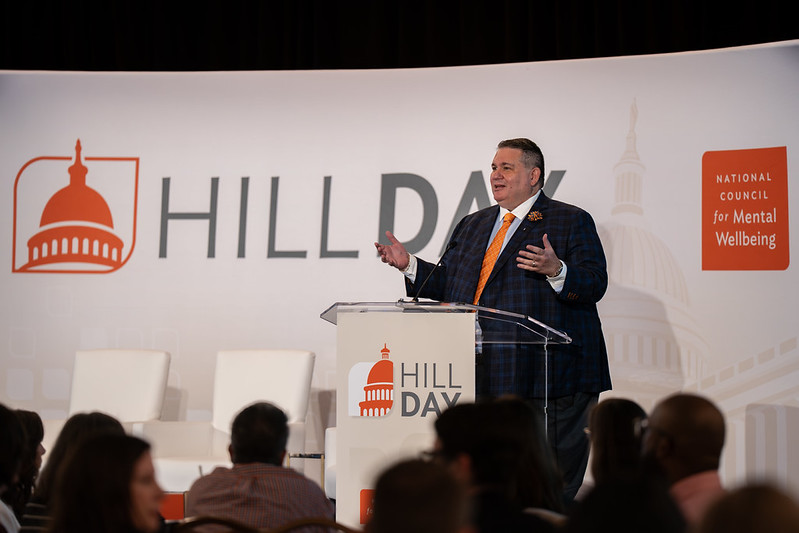
We host Hill Day every year so National Council for Mental Wellbeing members can meet with lawmakers and remind them that mental wellbeing is a nonpartisan issue.
This year, a prominent polling firm is helping us get that message across.
In a survey of 1,000 registered voters by conservative polling firm Fabrizio Ward, voters across the political spectrum expressed broad support for increased investment in programs that provide mental health and substance use treatment and care.
This important new survey found that 74% of swing voters (those who vote for candidates in both major parties) and 56% of Trump voters support expanding federal and state funding for Certified Community Behavioral Health Clinics (CCBHCs). Overall, 75% of respondents said they support expanding federal and state funding so more people can access high-quality mental health and substance use care through CCBHCs, with clear majorities across the political spectrum in support.
In addition, the poll found that:
- 95% of all voters believe it is important for people to have access to quality mental health and substance use care.
- 69% of all voters said they are more likely to support a candidate who backs efforts to expand CCBHC funding.
- 69% of all voters and 64% of swing voters are more likely to vote for candidates who support expanding CCBHC funding.
- 67% of all voters believe it is difficult to access mental health and substance use care.
So, what does the survey tell us? It reinforces the message that mental wellbeing is nonpartisan, and Republican and Democratic voters are united in recognizing the need to improve access to comprehensive mental health and substance use treatment and care.
It’s important that we share this poll and its results broadly, because a lot of work remains. For context, “the percentage of U.S. adults who report currently having or being treated for depression was 19.1% in the first quarter of 2026, similar to the high mark of 20.0% recorded the preceding quarter and up nearly nine percentage points since the initial measurement in 2015,” according to a recent Gallup Poll. These numbers suggest that approximately 51 million Americans currently experience depression, Gallup reported.
In addition, the Associated Press reported in May that “about 70,000 Americans died of drug overdoses last year — about 14% fewer than the previous year, according to preliminary government data.” It was the third year in a row that overdose deaths fell and the “longest decline in decades, according to federal data released [May 13].”
A lot of work remains, and this week hundreds of National Council members are meeting with lawmakers to discuss the importance of legislation to support people in need of treatment and care, as well as the organizations providing that care. The legislation includes:
- The bipartisan Ensuring Excellence in Mental Health Act (S.3402/H.R. 8487), which marks a significant milestone in efforts to expand access to lifesaving care through CCBHCs nationwide. The bill would ensure that CCBHCs can provide more services to older adults and people with disabilities by formalizing the model into Medicare. It also builds on existing requirements around care coordination to give all CCBHCs the option of providing additional primary care services.
- The Providing Empathetic and Effective Recovery (PEER) Support Act (H.R.2741/S.1329) would remove barriers and make it easier for people to become credentialed peer support specialists.
- The Promoting Effective and Empowering Recovery Services (PEERS) Act of 2025 (H.R.6841/S.3521) would authorize peer support services to be reimbursed by Medicare in community-based behavioral health settings and add definitions for “peer support services” and “peer support specialists” to the Medicare statutes.
- The Mental Health Access and Provider Support Act (H.R.8081/S.4202) would increase the Medicare reimbursement rate for clinical social workers, marriage and family therapists, and mental health counselors from 75% to 85% of the Physician Fee Schedule amount for covered mental health services.
- The Community Mental Wellness Worker Training Act (H.R.5733) would allow CCBHCs, community mental health centers, nonprofit hospitals and other community-based behavioral health organizations to train mental wellness workers.
- The Due Process Continuity of Care Act (H.R.1510/S.1720) would permit Medicaid payment for medical services furnished to individuals held in custody prior to adjudication (i.e., those who have not been tried or convicted of a crime).
- The Reentry Act of 2025 (H.R.2586) would allow Medicaid payment for medical services furnished to an incarcerated person during the 30-day period preceding their release.
- The WORK to Save Lives Act (H.R.7479/S.3812) would direct the Secretary of Labor, through the Occupational Safety and Health Administration, to issue voluntary guidance for employers and mandatory regulations for federal agencies on workplace opioid overdose reversal medication availability and training.
If that was all we had to do, it would be a lot. But it’s not all we’re working on. We’re focused on helping members understand how H.R.1 will affect them, and we’ve created the H.R.1 Hub to help them navigate the changes. We have a plan to develop new resources related to practice and change management throughout the year, to further support our members through this process.
We continue to work with Congress to identify ways to mitigate the effects of H.R.1, while also doing what we can to shape the best possible regulatory environment for our members in relation to H.R.1 implementation. Please rely on our H.R.1 resources as we lead the way to help members navigate the new law.
Please let your lawmakers know that these priorities matter to you. You can use this link to send a note directly to your lawmakers with a prewritten, editable message urging them to support these critical policy efforts. No one is immune from a mental health or substance use challenge, so we must do more to make mental wellbeing, including recovery from substance use challenges, a reality for everyone, everywhere.
Check out our press release on the Fabrizio Ward poll and the coverage in Politico (under “Public Health”).
Remember to like, share and repost this column so others know about the important work we do.