Where H.R.1 Creates Opportunities for Innovators

- Share
-

-

-

-

For the past several months, many founders have watched the headlines surrounding H.R.1 with understandable concern and confusion. Much of the reporting predicts that many organizations will experience genuine financial strain, implementation challenges, and increased administrative burden over the coming years.
But technology solutions and entrepreneurs should be careful not to conclude that these impacts will make Medicaid a less important market. Markets under pressure do not stop seeking solutions. Instead, they often become more disciplined about the problems they are willing to pay to solve. H.R.1 — and associated funds coming from the Rural Health Transformation Program — is also creating high-priority need and urgency around operational improvements required across the Medicaid ecosystem, resulting in opportunities for solutions that are diligently built for community behavioral health providers.
This series will explain changes related to H.R.1, describe their operational consequences, and examine where opportunities are emerging.
Understanding H.R.1’s Impact on Medicaid
It is most useful to think about H.R.1 as a collection of interrelated operational reforms. Many of these provisions require new administrative processes, additional documentation, greater coordination between organizations, new technology capabilities, and significant implementation efforts at both the state and provider levels. Some provisions shift financial incentives and increase the amount of work required to enroll, retain, and care for Medicaid beneficiaries. Collectively, they will have a significant impact on longstanding Medicaid funding mechanisms and how people function within the system on a day-to-day basis.
The provisions also create a need for an improved operating environment compared to what many innovators have been designing for over the past several years. Community providers now have to also navigate a more administratively complex Medicaid program while delivering high-quality care, protecting access to care, communicating with clients, preserving reimbursement, lowering costs, learning and operationalizing new technology systems, and implementing all of these changes with limited staff and resources.
Operational Challenges & Opportunities
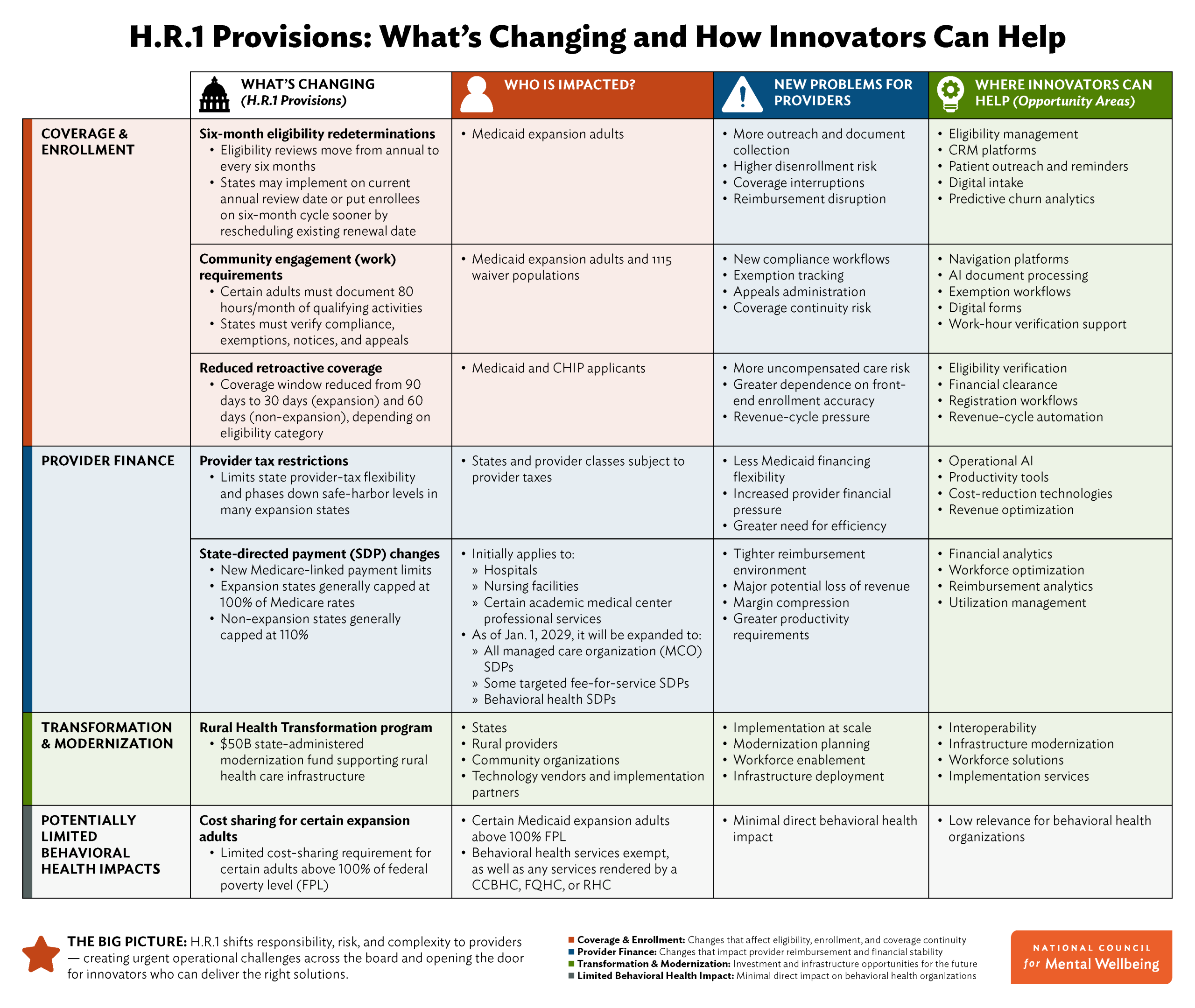
The Operational Impact of H.R.1 on Community Providers
- Administrative work becomes a strategic priority: Organizations will invest in technologies that automate administrative work, reduce staff burden, and protect reimbursement, rather than in standalone “innovation” or “transformation” projects.
- Coverage continuity becomes a business problem: Solutions that improve patient outreach, navigation, retention, and continuity of care become more valuable because they directly protect both outcomes and revenue.
- Operations leaders become key buyers: Many innovators will need to expand beyond clinical champions and build a value proposition around operational performance, workforce efficiency, and revenue innovation.
- State infrastructure requires modernization: Opportunities extend beyond providers. States will require implementation partners, workflow technology, interoperability solutions, communications platforms, and operational support.
- Financial pressure increases demand for measurable ROI: Customers will increasingly require a clear business case tied to operational savings, reimbursement protection, workforce leverage, or measurable efficiency improvements. Simply stating that a solution saves provider time or will improve outcomes downstream won’t be sufficient.
- Medicaid managed care organizations become more focused on retention and navigation: MCOs may place greater emphasis on outreach, predictive analytics, member engagement, care navigation, and continuity-of-care solutions that reduce avoidable disenrollment to help with operational costs, while also requiring measurable in-year financial ROI as described above.
- Implementation capacity becomes as important as the technology itself: Vendors that offer implementation support, configurable workflows, phased deployments, and change management may have an advantage over products that require the customer to contribute significant resources.
- Products that can be modular and easily customized will drive greater adoption and value: Not all community providers are the same, so solutions that can be tailored to customer-specific workflows and needs, consider unique state-by-state requirements, and offer modular implementation options based on the provider’s current needs and value will achieve greater market adoption and less future churn.
A Resource for Navigating H.R.1 Changes
Stay informed about H.R.1 changes — visit the National Council for Mental Wellbeing’s H.R.1 Resource Hub for expert guidance and updates. The hub contains accurate, timely, and actionable information on navigating H.R.1’s legislative changes, driven by experts in policy and practice improvement, and organized around the areas of greatest impact for mental health and substance use treatment organizations. For the most up-to-date information as further guidance is released, refer to the official Medicaid page.