Doing Good Doesn’t Mean Doing Everything
- Share
-

-

-

-

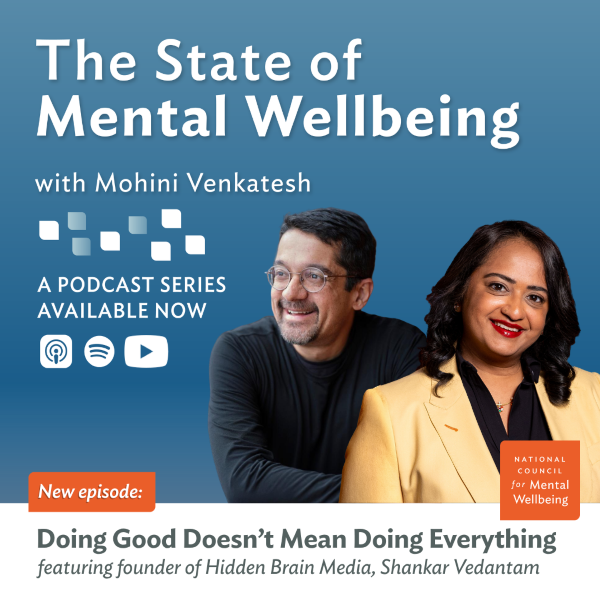
In this special, live episode of The State of Mental Wellbeing, recorded at NatCon, host Mohini Venkatesh sits down with Shankar Vedantam, host and executive editor of Hidden Brain, to explore how unconscious forces shape our decisions, relationships and responses to uncertainty. Their conversation offers practical insight for behavioral health leaders, mental health professionals and anyone working in care settings during times of change: focus on what is within your control, respond in alignment with your values and do not let the scale of a problem prevent you from taking meaningful action.
What You’ll Learn
Listeners will come away with a clearer understanding of:
- How the “hidden brain” shapes behavior: Learn how unconscious patterns, mental shortcuts and automatic processes influence the way people think, act and relate to one another.
- Why focus matters during uncertainty: Explore how attention, energy and emotional bandwidth affect decision-making in complex environments.
- How to move from helplessness to action: Understand why large-scale problems can make people feel powerless and how to stay committed to the good you can do.
- Why one meaningful action still matters: Reflect on how saving “the life in front of you” can be a powerful reminder for clinicians, caregivers and community leaders.
The Hidden Brain: Understanding the Unconscious Forces Behind Human Behavior
Vedantam begins by explaining the idea behind the “hidden brain”: the unseen mental processes that shape how people perceive the world, make decisions and respond to others. While most of us experience ourselves as deliberate and intentional, much of the brain’s work happens outside conscious awareness. He compares the mind to a stage production: what we notice is happening “front stage,” but countless systems are working “backstage” to make that experience possible.
For mental health and substance use professionals, this framing is especially relevant. Clients, patients and communities are often navigating emotions, habits, stress responses and unconscious patterns that influence behavior long before conscious reasoning enters the picture. Understanding the hidden brain can deepen empathy and help care teams approach human behavior with curiosity rather than judgment.
Staying Focused in Times of Uncertainty and Change
In a behavioral health landscape marked by uncertainty, workforce strain, policy shifts and evolving community needs, Vedantam points to a timeless lesson from the Stoic philosopher Epictetus: separate what you can control from what you cannot. Worrying about distant possibilities or replaying the past can drain energy without changing outcomes. Action, by contrast, is rooted in the present moment.
Responding with Values: Lessons from Epictetus and Marcus Aurelius
Vedantam also highlights a second Stoic insight: while we cannot always control what happens around us, we can choose how we respond. He connects this idea to Marcus Aurelius, the Roman emperor who applied Stoic teachings during periods of pandemic, war, grief, illness and political turmoil. The lesson is not to deny hardship, but to respond to it in a way that reflects our highest values.
When Problems Feel Too Big: Why Helplessness Can Stop Action
Vedantam also brings up research from psychologist Paul Slovic and a thought experiment inspired by philosopher Peter Singer. The scenario asks whether a person would save a drowning child if doing so meant ruining an expensive pair of shoes. Most people say yes. But when more children are introduced — children too far away to save — the emotional calculus begins to shift.
Vedantam uses this example to explain how large-scale suffering can create a sense of helplessness. When people are confronted with everything they cannot fix, they may become less likely to do the good that is within reach. This insight matters deeply in mental health, substance use care and public health, where the scope of need can feel enormous. The challenge is to avoid letting the size of the problem obscure the value of one concrete action.
Doing the Good You Can: The Power of One Meaningful Action
The episode comes full circle with a practical takeaway: do not let what you cannot do prevent you from doing what you can. In behavioral health, that might mean supporting one client, improving one workflow, reaching out to one colleague or taking one step toward a more compassionate system of care. Meaningful change is often built through small, focused actions repeated over time.
For anyone navigating uncertainty, burnout or the pressure to solve problems that feel too large, Vedantam’s message is both grounding and hopeful: the action in front of you matters. You do not have to do everything to do good.
Meet the Guest: Shankar Vedantam
Shankar Vedantam is the host and executive editor of the Hidden Brain podcast and radio show, which explores the unconscious patterns that drive human behavior, shape decisions and influence relationships. He founded Hidden Brain Media in 2019 and has spent more than 25 years reporting on human behavior and social science research. Before launching Hidden Brain Media, Vedantam served as NPR’s social science correspondent and spent a decade as a reporter at The Washington Post, where he wrote the Department of Human Behavior column. He is the author of The Hidden Brain: How Our Unconscious Minds Elect Presidents, Control Markets, Wage Wars, and Save Our Lives and has been recognized with multiple journalism honors, including an Edward R. Murrow Award.
Key Takeaway
This conversation is a reminder that mental wellbeing is shaped not only by external circumstances, but also by attention, perception, unconscious patterns and the choices we make in response to the world around us. In moments of uncertainty, progress begins by focusing on what is possible now — and taking the next right action.
Listen to the Full Conversation
This post highlights the main themes of the discussion, but the full episode offers deeper insight, perspective and practical guidance for mental health professionals, substance use treatment providers, behavioral health leaders and anyone working to support wellbeing during uncertain times.
Stream the full episode here, or listen on your favorite platform to hear the complete discussion.