A Global Approach to Addressing Mental Health & Substance Use
- Share
-

-

-

-

What can the United States learn from global mental health leaders about workforce shortages, crisis response, peer support and access to care?
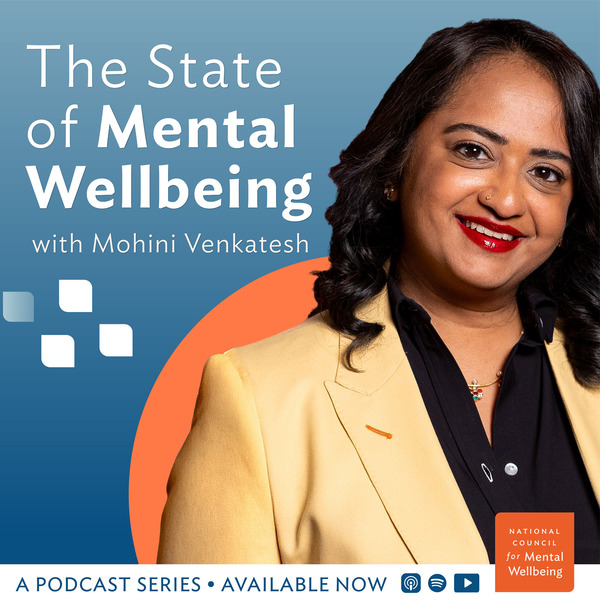
In this episode of The State of Mental Wellbeing, Mohini Venkatesh speaks with Steve Appleton, President and CEO of the Global Leadership Exchange, and Chuck Ingoglia, President and CEO of the National Council for Mental Wellbeing. Together, they explore how international knowledge exchange can strengthen mental health care, substance use treatment and disability services.
The conversation focuses on several urgent behavioral health issues, including workforce development, peer-led crisis alternatives, task sharing and the need for more flexible, community-based models of care.
For behavioral health leaders, policymakers, providers and advocates, the message is clear: no single country has all the answers. But shared learning can help build stronger, more responsive systems.
What You’ll Learn
This episode offers practical lessons for leaders working to strengthen behavioral health systems, expand access to care and rethink traditional service models.
- Why the behavioral health workforce shortage is a global challenge, not just a U.S. problem.
- Why leadership development and innovation are essential to sustainable system change.
- How global knowledge exchange can help states, communities and organizations adopt new ideas faster.
Global Mental Health Challenges Are More Shared Than We Think
It is easy to assume the challenges facing mental health and substance use systems in the United States are unique. But one of the strongest themes in this conversation is that leaders across the globe are dealing with many of the same issues.
Countries everywhere are grappling with workforce shortages, rising demand for care, crisis response pressures and the need for services that better reflect local communities. That is why global mental health collaboration matters. When leaders can see what is working elsewhere, they do not have to start from scratch.
The Global Leadership Exchange creates space for that kind of learning. It brings leaders together across countries and sectors to discuss what worked, what failed and what others can learn from both.
That kind of openness is valuable. Too often, health care case studies focus only on polished success stories. By contrast, The Global Leadership Exchange helps leaders talk honestly about implementation restrictions such as staffing shortages, financing limits and the challenge of leading change under pressure.
The Workforce Shortage Is a Global Behavioral Health Crisis
Across mental health care, substance use treatment and disability services, countries are struggling to recruit, train and retain enough professionals to meet growing need. The shortage affects social workers, psychiatrists, nurses and allied health professionals, but it also reaches supervisors, managers, peer support workers and emerging leaders.
At the same time, more people are seeking help. In many cases, that is a sign of progress because stigma has decreased and awareness has improved. But it also means systems must respond to higher demand with a workforce that is already stretched thin.
The conversation also makes clear that systems cannot simply recruit and train their way out of this challenge. Training pipelines take years. Licensing structures create bottlenecks. Financial, testing and caregiving restrictions can delay or prevent professionals from entering independent practice.
That is why leaders are being pushed to think differently about workforce development, team-based care and the kinds of roles that can be strengthened to expand access.
Why Leadership Development Matters in Behavioral Health
Leadership development is often overlooked in health care transformation. Behavioral health systems spend significant time talking about financing, staffing and compliance. They spend less time discussing what it takes to develop leaders who can inspire improvement, support innovation and guide teams through uncertainty.
Leadership and management are both necessary, but they are not the same. Good management helps organizations meet operational goals. Strong leadership creates the space for people to think differently, take informed risks and build better systems over time.
That distinction matters in high-pressure environments where performance targets, budgets and workforce instability leave little room for reflection. Yet innovation rarely happens without that space.
The Future of Behavioral Health Depends on Shared Learning
If there is one idea that runs through this conversation, it is that behavioral health systems cannot solve today’s challenges in isolation.
Workforce shortages, crisis response gaps, fragmented services, rising demand and uneven access to care are too complex for any one organization or country to address alone. But collaboration creates possibility.
When leaders connect across sectors, states and countries, they can exchange ideas, test new models and adapt proven approaches more quickly.
Meet the Guest

Steve Appleton serves as President and Chief Executive of Global Leadership Exchange (GLE). Prior to this, Steve was Managing Director of a consultancy and research practice specializing in work relating to mental health, housing, disability and older age. He has worked nationally and internationally on population-based mental health improvement programs in cities and urban regions. Alongside his role with GLE Steve also serves as Chair of the Board of the Association of Mental Health Providers in England and Wales, and Chair of the Board of Beacon CHC.
Listen to the Full Conversation
This post highlights the major themes from the conversation, but the full episode offers even more insight into global mental health leadership, workforce innovation, crisis response, peer support and practical ideas for strengthening behavioral health systems.
Stream the full episode here, or listen on your favorite platform to hear the complete discussion.