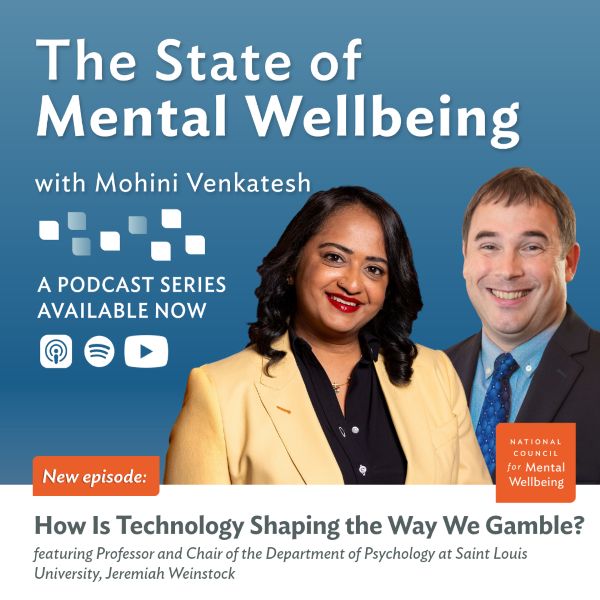
How is Technology Shaping the Way We Gamble?
- Share
-

-

-

-






Dr. Jeremiah Weinstock, PhD, saw his first gambling client when he was still in his graduate training program. At that point, gambling meant getting to a casino, and 30- to 45-minute drive. Today, a bet is a few taps away on the phone in your pocket. In this episode, Dr. Weinstock, joins The State of Mental Wellbeing to talk about how technology, policy and marketing have reshaped gambling, who is most at risk, and what behavioral health professionals and organizations can do about it.
What You’ll Learn
- How mobile technology has removed the barriers that once separated people from gambling.
- Why gambling-like mechanics in video games and other products are a concern for young people.
- Which populations may be at higher risk, and why gambling disorder so often overlaps with substance use.
- How gambling affects the brain, and how marketing and normalization keep people engaged.
- Practical steps behavioral health organizations can take, and evidence-based lower-risk limits for gambling.
Technology Has Removed the Friction
Dr. Weinstock explains that the biggest change over the past two decades is accessibility. Think of the old horse track: you had to walk to the track, stand in line to place a bet, watch the race, and stand in line again to collect. Now an online slot game can play out in seconds. That speed matters because, for many people, gambling is less about the money than about the moment of anticipation, the stretch between pressing “spin” and seeing the result. Technology has made that moment far easier to reach, through online casino games, sports betting and in-game betting on things like the next pitch.
He points to New Jersey as one of the clearest examples. The state was the first to legalize sports betting after the 2018 Supreme Court decision and has also legalized iGaming, which brings casino-style games to the computer. He added that policy has largely focused on expanding access, and that responsible gaming tools are opt-in, so people have to find them and many don’t think the tools apply to them.
Gambling Mechanics Are Showing Up Everywhere
Gambling is no longer limited to gambling products. Dr. Weinstock shares a story about a 13-year-old who said he “lost a bet” in a baseball video game. The game asked him to predict a winner and rewarded a correct guess with a special player card. No money was involved, but, as Dr. Weinstock puts it, “all the mechanics of gambling are there.” Loot boxes work in a similar way. They are essentially slot machines built on variable ratio reinforcement, where unpredictable rewards keep players coming back.
Who May Be at Higher Risk
Dr. Weinstock says there is an intersection with nearly every population, but he highlights several groups of particular concern:
- Children, teens and college students: The earlier someone is exposed to an addictive behavior, the more likely they are to develop problems. Dr. Weinstock noted that half of all men ages 18 to 49 have a sportsbook app on their phone, and that prediction market products can be used legally starting at age 18. College students face added risk as independence grows and peer norms push participation.
- People with substance use disorders: About a third of people with gambling disorder have a current or lifetime history of a substance use disorder. In substance use treatment clinics, about 20% have a current or lifetime history of gambling disorder.
- Military members and veterans: Exposure to trauma, higher rates of substance use and downtime on active duty can all raise risk.
- People experiencing homelessness: For some, gambling can be an act of economic desperation, such as hoping a $5 scratch ticket will pay off.
- Older adults: Casinos are user-friendly, open around the clock and can offer social connection for people who are lonely, and some independent living communities even organize trips.
What Gambling Does to the Brain
The overlap with substance use isn’t a coincidence. According to Dr. Weinstock, MRI studies show that the dopamine release from a big gambling win is comparable to that from cocaine, and about three and a half times higher than the strongest natural reinforcer people encounter.
Marketing That Makes Gambling Feel Normal
Phones also come with notifications, pop-ups and promotions. Dr. Weinstock describes offers like “deposit $10, get $350 in risk-free bets” and profit boosters as ways of working people into a pattern of gambling.
Marketing also plays on fear of missing out and sends the message that gambling is what everyone is doing. Dr. Weinstock points to a study of NBA and NHL broadcasts that found a gambling-related message roughly every 20 seconds, and to point spreads that are now a routine part of sports coverage. For young people, that constant presence makes betting feel like an ordinary part of fandom.
What Behavioral Health Professionals and Organizations Can Do
Dr. Weinstock acknowledges that behavioral health professionals already have full plates, and that gambling can sound like “one more thing.” But the issue is already affecting treatment, underscoring why gambling disorder belongs in the broader addiction conversation.
For organizations, he offers a few concrete starting points:
- Pair screening with a plan. If gambling screening items are added to intake, make sure there is a plan for what happens when someone screens positive.
- Build in-house expertise. Support a staff member in earning gambling disorder certification, which involves a 30-hour training and supervised hours, and give them the time and energy to do it.
- Integrate, don’t start from scratch. Dr. Weinstock believes “addiction is addiction is addiction,” with 80% to 90% overlap in clinical approach. Cognitive behavioral therapy, trauma-informed care and medication all still apply. Organizations can include people with gambling disorder in existing substance use groups and add a few gambling examples before deciding whether a dedicated track is warranted.
- Address irrational beliefs. The biggest clinical addition for gambling is cognitive restructuring around maladaptive beliefs, such as feeling “lucky.”
Know the Lower-Risk Limits
Gambling disorder is often called a hidden addiction. There are no obvious signs of intoxication, and the warning signs, like irritability, lying, sleepless nights and financial stress, can have many other explanations. That’s why Dr. Weinstock wants more people to know that evidence-based lower-risk limits exist. They apply across all forms of gambling, including casinos, horse racing, sports betting and prediction markets:
- Gamble no more than once a week.
- Spend no more than 1% of your monthly pre-tax income, which is roughly $50 to $60 a month for many people.
- Stick to no more than three different types of gambling.
Routinely exceeding any one of these limits carries a risk of harm, which makes them a useful foundation for public health messaging.
Where to Find Help
If you are concerned about your own gambling or a loved one’s, Dr. Weinstock recommends starting with the gambling helpline. The national number is 1-800-MY-RESET, and every state also has its own helpline. Helplines offer a non-judgmental, non-stigmatizing person to talk to. Many states offer free treatment for gambling disorder, and the helpline can connect callers with a local provider in person or by telehealth for an assessment.
Meet the Guest
Dr. Jeremiah Weinstock is a professor and chair of the Department of Psychology at Saint Louis University and a licensed psychologist board certified in addiction psychology. His research and clinical work specialize in gambling disorder, its treatment and the rapidly changing landscape of sports betting. He has conducted gambling research for more than two decades and has extensive experience training behavioral health professionals in the conceptualization, assessment and treatment of gambling disorder. His work seeks to translate research into practical evidence-based approaches to prevent gambling-related harm and improving care for people experiencing gambling problems.

Listen to the Full Conversation
This post highlights the main themes of the discussion, but the full episode offers deeper insight, perspective and practical guidance for behavioral health professionals, organizational leaders and anyone concerned about the role of technology in gambling.
Stream the latest episode right here, or listen on your favorite platform.