How to Solve Problems by Starting at the End
- Share
-

-

-

-






Behavioral health challenges rarely stay within the boundaries of a single agency, provider or funding stream. Mental health and substance use affect health care, housing, education, employment and public safety. Yet these systems often operate separately, with different priorities, timelines and definitions of success.
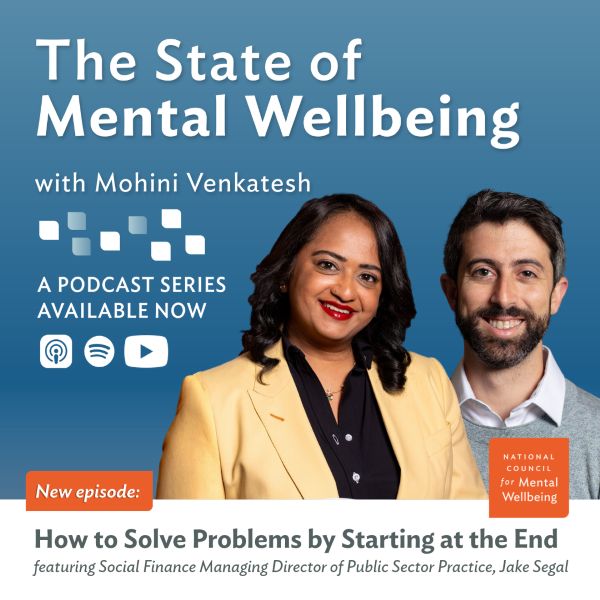
In this episode of The State of Mental Wellbeing, host Mohini Venkatesh speaks with Jake Segal, managing director of public sector practice at Social Finance, about building partnerships capable of addressing complex public sector problems. Their conversation explores outcomes-based contracting, value-based care, consumer engagement, adaptive leadership and the role of behavioral health across government and community systems.
At the center of the discussion is one deceptively simple principle: Start by defining the outcome you want, then work backward.
What You’ll Learn
Listeners will come away with a clearer understanding of:
- How outcomes-based contracting can shift attention from process compliance to meaningful results for individuals and communities.
- Why consumer voices should shape outcome selection, program oversight and ongoing governance.
- How behavioral health leaders can build cross-sector partnerships with health care, housing, education and public safety.
- Why flexible implementation, reliable data and frequent feedback are essential when evidence is uncertain.
- How small changes to incentives and performance measures can improve public systems without requiring complete reinvention.oaches can build trust and emotional safety with young athletes
Moving From Programs to Outcomes
Public sector partnerships often begin with organizations defending particular programs, budgets or operating models. Segal recommends a different starting point: Bring stakeholders together to identify the result they collectively want to achieve.
That shared result might be long-term housing stability, lower recidivism, fewer preterm births or greater independence for people with serious mental illness. Once stakeholders agree on the outcome, they can determine how to measure progress, evaluate results and establish each partner’s role.
This approach does not eliminate disagreements. It gives participants a common destination, allowing them to debate strategies without losing sight of why they entered the room.
For behavioral health leaders, this orientation can help bridge differences among providers, payers, policymakers and community partners. It also redirects attention from whether an organization completed a prescribed activity to whether people experienced meaningful improvements.
What Is Outcomes-based Contracting?
Outcomes-based contracting connects payment and accountability to defined results rather than relying exclusively on activities, processes or compliance requirements.
Segal describes outcomes-based contracting and value-based care as “first cousins.” Both link payment to results, but outcomes-based arrangements may place greater emphasis on multiyear, policy-relevant outcomes and flexible service delivery.
This longer horizon can be especially valuable for prevention. Health and human services systems frequently operate on annual performance cycles, even though preventive interventions may take years to generate measurable benefits. Multiyear agreements can give organizations more time to invest, learn and demonstrate impact.
Centering Consumers in Behavioral Health Outcomes
Consumer engagement should extend beyond an initial listening session. Segal argues that people with lived experience should participate in oversight and governance, helping leaders interpret results and adjust implementation.
He points to an outcomes-based contract addressing chronic homelessness in Anchorage, Alaska. Its governance committee includes a community representative with lived experience of homelessness and regularly hears from others affected by the system. This structure grounds decision-making in the realities of the people the initiative is intended to serve.
In behavioral health, that principle could help systems move beyond narrow utilization measures toward outcomes such as independence, quality of life, satisfaction, stability and participation in the community.
Why Adaptive Leadership Is Essential
Traditional public sector accountability often treats compliance as proof of success: Define the process, procure it and confirm that every requirement was followed. But complex human services interventions rarely unfold exactly as planned.
People’s needs vary. Local conditions change. Research findings do not always transfer neatly from one population or community to another. A rigid model may execute the original plan perfectly while failing to achieve the desired result.
Segal argues that adaptability should be designed into delivery and governance. Leaders need timely data, meaningful feedback and enough flexibility to revise an approach when it is not working. That does not mean abandoning rigor or accountability. It means holding firmly to the intended outcome while remaining open about how to reach it.
Effective public sector leaders, he says, recognize uncertainty without allowing it to become an excuse for inaction. They focus on what is most important, accept that improvement may look imperfect and make thoughtful changes before every question has a definitive answer.
Behavioral Health as a Cross-sector Solution
Mental health and substance use needs appear in emergency departments, schools, jails, housing programs and social service agencies. When communities underinvest in behavioral health or make services difficult to access, other systems absorb the consequences.
This is sometimes called a “wrong pockets” problem: One organization pays for an intervention while the financial benefits appear in another agency, sector or level of government. For example, specialty behavioral health providers may bear the cost of integrating primary care, while the resulting savings accrue elsewhere in the health system. Aligning partners around shared outcomes can help overcome this disconnect by making the collective value of prevention visible — even when no single budget captures the full return.
This creates an opportunity for behavioral health leaders. They can help partners in public safety, education, health care and housing solve some of their most persistent challenges. Segal describes an effective approach as servant leadership: sharing credit, helping other sectors achieve their goals and demonstrating how behavioral health services can unlock broader success.
Evidence, Uncertainty and Better Data
Evidence-based policy is critical, but social interventions operate in environments more variable than controlled clinical settings. An intervention that succeeds in one place may produce different results elsewhere because populations, providers and local conditions differ.
Segal cautions against overstating certainty. Decision-makers may hesitate to invest in housing, food access or other nonclinical drivers of health when the evidence is variable and the financial return is unclear. Outcomes-based funding can provide one way to act responsibly amid that uncertainty by linking payment to achieved results.
This approach still depends on strong measurement. Leaders must identify data that is accessible, reliable and timely. They must also consider whether conventional administrative metrics reflect what consumers value.
Client satisfaction and consumer-reported outcomes could create faster feedback loops, improve quality and ensure that success is not defined solely by what institutions can count conveniently.
Innovation Does Not Have to Mean Novelty
Organizations under pressure to improve often pursue a new platform, pilot or model. But meaningful change does not always require starting over or chasing the latest idea. Innovation and novelty are not the same, as Segal notes.
Meaningful innovation may involve combining existing tools more effectively or changing a single incentive. Segal discusses Wisconsin’s Temporary Assistance for Needy Families workforce system, where providers were rewarded for job placements even when those positions were short-term and poorly paid. Redefining performance around earnings and stability better aligned payment with the result participants needed.
The intervention was not flashy. It was a focused change to what the system rewarded. That illustrates a central lesson for behavioral health transformation: Leaders do not always need to rebuild everything. A clearer outcome, better measure or more useful feedback loop can generate lasting improvement.
Working Backward to Move Forward
Complex systems will always involve competing priorities, uncertain evidence and practical constraints. Successful partnerships do not wait for those tensions to disappear. They create alignment by defining the desired result, identifying who belongs in the conversation and working backward toward a strategy.
For behavioral health leaders, that means centering consumers, collaborating across sectors and distinguishing accountability from rigid compliance. It also means using data without pretending that numbers eliminate uncertainty.
The strongest systems keep the outcome steady while allowing the path to evolve. As Segal’s examples show, progress can begin with a modest but consequential question: What are we trying to achieve?
Meet the Guest
Jake Segal is Social Finance’s managing director for the public sector practice. He oversees the firm’s work to help governments achieve better outcomes. That work is about connecting money, data and partners around effective delivery, and linking payment to results.
The public sector practice largely focuses on early childhood, job readiness, health and behavioral health, benefits access and homelessness. Segal is especially interested in how funding models can overcome deep problems of impact uncertainty. He is aware that he’s a nerd.

Listen to the Full Conversation
This post highlights the main themes of the discussion, but the full episode offers deeper insight, perspective and practical guidance for behavioral health leaders, policymakers, public sector professionals, health care providers and community partners working to improve complex systems.
Stream the latest episode right here, or listen on your favorite platform.