Safe, Supported, Expected, Rewarded: A Road Map for AI Adoption
- Share
-

-

-

-






Artificial intelligence is rapidly changing how organizations operate, innovate and serve people. Behavioral health leaders understand that AI will influence the future of care. The question is how to adopt it in ways that strengthen their mission, support staff and improve outcomes.
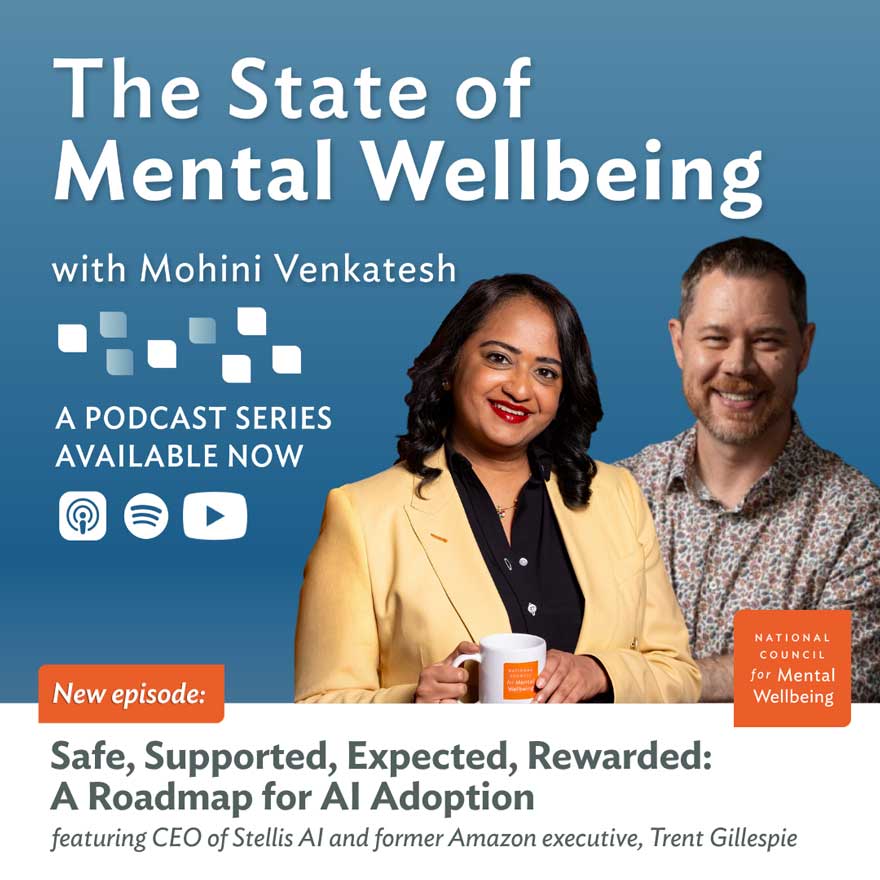
In this episode of The State of Mental Wellbeing: A Podcast on Mental Health & Substance Use, host Mohini Venkatesh talks with AI expert and former Amazon executive Trent Gillespie about what successful AI adoption actually looks like. Drawing on lessons from Amazon and his work with organizations across industries, Gillespie shares a practical framework for helping teams embrace AI while building trust, confidence and long-term organizational capability.
What You’ll Learn
Listeners will come away with a clearer understanding of:
- Why AI requires leadership engagement and strategic planning, not just technology deployment.
- How to create an environment where AI use is safe, supported, expected and rewarded.
- Practical approaches for building trust, encouraging experimentation and accelerating workforce learning.
- How AI can help behavioral health organizations expand access, reduce administrative burden and create more meaningful human connections.
Why Leaders Need to Think Bigger About AI
Many organizations are still treating AI as just another software tool. Gillespie sees something much larger underway.
“I consider it rewiring how your organization works today,” he said, emphasizing that AI has implications for nearly every process, workflow and service experience. Because of that, decisions about AI belong in the leadership conversation alongside strategy, workforce development and organizational growth.
Gillespie encourages leaders to imagine their “future client” and ask what people will expect five or 10 years from now. Organizations that begin preparing for those expectations today will be better positioned to meet growing demand and adapt to changing needs.
A Simple Framework for AI Adoption
One of the conversation’s most practical takeaways is Gillespie’s four-part approach to adoption: Make AI use safe, supported, expected and rewarded.
Make It Safe
For employees, safety is about more than data privacy. Organizations need clear policies, approved tools, workforce training and transparent conversations about how AI may affect roles and responsibilities. Gillespie notes that uncertainty remains widespread, making it critical for leaders to address people’s concerns directly and create confidence around responsible use.
Make It Supported
Adoption accelerates when employees have opportunities to learn together. Training, shared resources and peer-to-peer knowledge exchange can help organizations move from isolated experimentation to collective learning. Gillespie recommends creating systems that allow employees to share successful use cases and build organizational knowledge over time.
Make It Expected
Many organizations encourage experimentation but hesitate to establish clear expectations. According to Gillespie, the expectation should center on learning and improvement. “It’s learning, experimenting and improving your work with these tools,” he said. Leaders who encourage employees to apply AI to recurring challenges and important workflows help build an organizational culture of innovation and continuous improvement.
Make It Rewarded
Recognition reinforces change. Whether through public acknowledgment, professional growth opportunities or small incentives, rewarding employees who share insights and improve processes can help sustain momentum. Even simple recognition can send a powerful message about organizational priorities.
Start Before You Feel Ready
A common barrier to adoption is the desire to have everything figured out before taking action.
Gillespie sees organizations spending significant time searching for the perfect plan when small experiments could generate valuable learning immediately. His advice is straightforward: “The best thing to do is just to start.”
Through what he calls “AI sprints,” teams can test ideas, evaluate results, share lessons and continuously improve. This approach builds confidence while helping organizations develop AI skills incrementally, rather than waiting for a large-scale transformation effort.
Expanding Access Through Innovation
For behavioral health organizations, AI presents powerful opportunities to expand access to care. Gillespie points to the millions of people who still lack access to mental health services and challenges leaders to think creatively about how AI can help close that gap. Applications such as onboarding, care coordination, documentation and administrative workflows can increase organizational capacity and free up staff time for higher-value work.
The discussion also explores how AI can help clinicians focus more deeply on the human side of care. By reducing time spent on documentation and operational tasks, organizations may be able to create more meaningful interactions between providers and the people they serve.
Preparing for the Future
Near the end of the conversation, Gillespie returns to a theme that runs throughout the episode: Leaders must build for the future, not simply respond to the present. Personalized experiences, more efficient onboarding and enhanced support are quickly becoming expectations rather than innovations. Organizations that begin building toward that future now will be better prepared to deliver on their mission in the years ahead.
For leaders navigating uncertainty, Gillespie’s message is clear: Start learning, start experimenting and create a workplace culture where innovation can thrive. The organizations that make AI safe, supported, expected and rewarded will be best positioned to serve both their workforce and their communities.
Meet the Guest

Trent Gillespie is a former Amazon executive who left one of the world’s most powerful AI companies to serve the organizations it was disrupting. He brings that insider perspective to every stage he walks onto, and he translates it into something the audience can act on before they leave the room. Not someday. Monday morning.
Listen to the Full Conversation
This post highlights the main themes of the discussion, but the full episode offers deeper insight, perspective and practical guidance for behavioral health leaders exploring AI strategy, organizational change management and workforce adoption.
Stream the latest episode right here, or listen on your favorite platform.