
- Share
-

-

-

-

Serious mental illness (SMI) takes a massive toll on the individuals with the diagnosis and on the people around them. These conditions — including schizophrenia, schizoaffective disorder, bipolar disorder and severe depression — are difficult to treat.
Nearly 3 million people in the U.S. have been diagnosed with schizophrenia, and many aren’t receiving the help they need. How can we bolster the care provided to people diagnosed with schizophrenia? Bristol Myers Squibb (BMS) and the National Council for Mental Wellbeing have a plan.
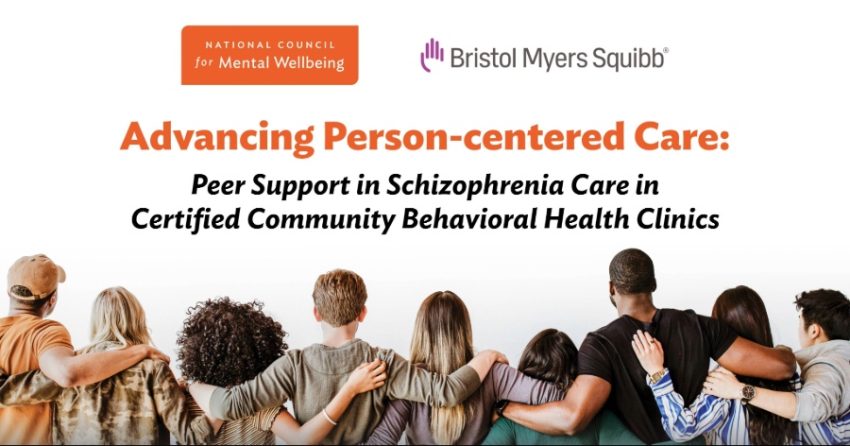
We’ve collaborated on a new white paper, Advancing Person‑centered Care: Peer Support in Schizophrenia Care in Certified Community Behavioral Health Clinics, that describes how two CCBHCs are employing peer support workers to care for clients with schizophrenia. It offers guidance on the best, most innovative practices for developing and providing behavioral peer support services for people living with schizophrenia.
One of the clinics evolved the peer support specialist role from “serving as a catchall resource to providing a focused scope of essential, clearly defined contributions within the care team,” the paper reports. Peers were “empowered to integrate more effectively into care teams and clients’ care programs,” which ultimately refined the peer support worker role.
The paper describes one of the greatest strengths of the peer workforce — to remind the care team and the people being served that recovery is possible — and explains how to capitalize on that strength. Recommendations for scaling peer support in schizophrenia care include:
- Establishing clear program infrastructure, defined roles and documented workflows.
- Integrating peer support workers into multidisciplinary care teams with joint training.
- Strengthening workforce development through onboarding, supervision and compensation.
- Making peer support services visible and accessible through proactive outreach and streamlined referral pathways.
- Tracking meaningful outcomes using both quantitative data and narrative measures.
- Advocating for policy reforms, including standardized certification and improved Medicaid reimbursement, to ensure sustainable funding.
CCBHCs provide an ideal setting to expand peers’ role in the care of clients with schizophrenia. These clinics already deliver integrated communitybased services regardless of a person’s ability to pay, reducing emergency department use, improving access and filling gaps in traditional systems of care.
And peer support workers already have carved out a role within CCBHCs, according to the 2024 CCBHC Impact Report. Among the most commonly reported types of newly hired staff at Medicare CCBHCs were care coordinators (with 85% of CCBHCs reporting they have hired these roles), data analysts (85%), non-MD licensed clinicians (78%), peer support workers (77%) and nurses (67%).
Not enough CCBHCs currently employ peers in schizophrenia care. But the paper points out that with a coordinated effort, peer support can become a consistent, evidencebased component of this care, improving recovery, continuity and the quality of life for the estimated 3 million people diagnosed with schizophrenia.
I encourage you to check out Advancing Person‑centered Care: Peer Support in Schizophrenia Care in Certified Community Behavioral Health Clinics and consider how you might apply these insights.
Then, join us at NatCon in just a few weeks to discuss this important work. A breakout session titled “Trust, Connection and Continuity: The Opportunity of Peer Support in Care for People With SMI” is scheduled for Monday, April 27. Check out the sessions in our peer support track for more details.
This is such an important topic. I want to hear what you have to say, so please leave a comment below. Like, share and repost this column so others can learn about this effort to improve care for people with schizophrenia.