Why Investors Are Banking on Behavioral Health
- Share
-

-

-

-






Behavioral health is attracting growing attention from investors, entrepreneurs and technology innovators. But contrary to common assumptions, the most promising opportunities are not just about financial returns. Increasingly, investors are looking for ways to support technologies that improve access to care, strengthen provider organizations and create better outcomes for individuals and communities.
This is where impact investing comes in.
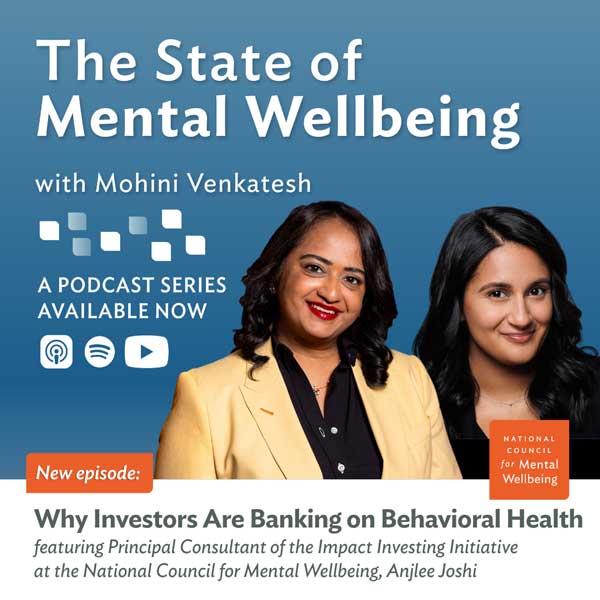
In the latest episode of State of Mental Wellbeing, National Council for Mental Wellbeing Chief of Staff Mohini Venkatesh sits down with Anjlee Joshi, a behavioral health impact investing expert who advises the National Council’s investment portfolio. They explore what impact investing is, why investor interest in behavioral health is evolving, and how providers, founders and investors can work together to drive meaningful change.
What You’ll Learn
Listeners will come away with a clearer understanding of:
- What impact investing is and how it’s helping drive innovation in behavioral health care.
- Why investors, startups and providers are increasingly working together to address mental health and substance use challenges.
- How the National Council serves as a bridge between behavioral health organizations and emerging technologies.
- What it takes for behavioral health innovations to deliver both financial sustainability and meaningful community impact.
What Is Impact Investing in Behavioral Health?
Impact investing is a form of private-company investing that considers both financial returns and measurable social impact. As Joshi put it, “Impact investing is not just, are we making money off the companies we’re investing in, but are the people those solutions are serving actually doing better?” Rather than evaluating success solely by profitability, impact investors assess whether a technology is creating positive outcomes for the people and communities it serves.
In behavioral health, those outcomes may include improved clinical results, better access to care, reduced administrative burden, stronger workforce support and more sustainable community-based services. For the National Council, investing provides another avenue to influence the future of care alongside policy advocacy, training and education.
Why Behavioral Health Has Become an Investment Priority
Several forces have increased investor interest in behavioral health. The COVID-19 pandemic accelerated the adoption of telehealth and digital care, demonstrating how technology can expand access and flexibility. At the same time, rising awareness of mental health and substance use needs highlighted persistent workforce shortages, access challenges and operational inefficiencies.
Joshi describes the market as entering a more measured phase. Earlier investment often emphasized virtual care and growth at all costs. Today, investors are paying closer attention to practical, operational solutions that help providers manage everyday challenges. These innovations may not generate splashy headlines, but tools that streamline compliance, strengthen training or simplify workflows can return valuable time to staff and help organizations focus on care.
The National Council’s Role in Behavioral Health Innovation
A central theme of the conversation is the National Council’s role as a bridge among behavioral health providers, technology companies and investors. Community-based providers operate within complex reimbursement models, regulatory environments and workforce realities that can be difficult for outside innovators to understand. Many startups bring strong ideas and a sincere desire to help, yet they lack experience navigating those systems.
Bridging these worlds creates value on both sides. Providers gain access to solutions that have been assessed for real-world applicability, financial viability and potential impact. Founders receive candid insight into how provider organizations operate, how they are paid and what implementation truly requires. This exchange can shape products, improve rollout strategies and reduce the risk of adding disruption to already overburdened teams.
What Makes a Behavioral Health Startup Worth Supporting?
Not every promising company is a strong investment opportunity. Joshi points to several criteria for consideration: alignment with provider needs, demonstrated use in behavioral health settings, financial sustainability, measurable impact and a leadership team that welcomes feedback.
The willingness to learn is especially important. Behavioral health providers and the people they serve are not a monolith. Successful founders approach the field with curiosity and humility, seek to understand day-to-day realities and adapt their products accordingly. Passion is crucial, but it must be paired with an understanding of the clinical, financial and regulatory complexity of the field.
Measuring Impact Beyond Financial Returns
A defining feature of impact investing is the commitment to measuring results. The National Council evaluates portfolio companies using standard financial indicators and impact measures tailored to each offering. Metrics may include the number of National Council members served, applications successfully processed, professionals trained or clinicians supported toward licensure, or the amount of revenue generated for providers.
The episode offers several examples of tangible value. One portfolio company supports specialty credentialing that has helped providers qualify for enhanced reimbursement. Another uses AI-powered patient simulations to support training and hiring without recording live clinical sessions. Other companies automate operational and compliance work, giving staff time back to focus on higher-value responsibilities and the people they serve.
These examples show how meaningful impact often comes from targeted improvements. A tool does not have to replace an organization’s entire technology stack to make a difference. Removing one stubborn paperwork burden, improving one hiring decision or unlocking one reimbursement pathway can strengthen a provider organization and improve the experience of care.
Looking Ahead: The Future of Impact Investing
Impact investing offers a framework for uniting providers, policymakers, entrepreneurs and investors around a shared goal: advancing solutions that are financially sustainable, operationally realistic and genuinely useful to communities.
The National Council’s experience shows that investing is about far more than writing a check. It can expand an organization’s network, increase its fluency in innovation and create new ways to influence the future of care. When investors play both offense and defense, championing companies while holding them accountable, capital can help behavioral health innovation move in a more responsible direction.
Meet the Guest
Anjlee Joshi leads the impact investing work for the National Council for Mental Wellbeing, which prioritizes investing in solutions that drive impact and innovation for members, alongside strengthening member innovation capabilities and enabling technology companies to better understand and serve them. For the past five years, Joshi has advised nonprofits, startups, health plans and health systems on creating sustainable and impactful solutions. Prior to this, she spent five years at Optum Behavioral Health as the VP of Strategy and Business Development, as well as the Director of OptumLabs, an observational evidence and machine learning R&D lab. She has also served in performance improvement and quality roles at Brigham and Women’s Hospital in their inpatient psychiatry, detox units and ERs. Joshi is passionate about creating systemwide changes to support solutions and ensuring those innovations are reaching all communities of need.

Listen to the Full Conversation
This post highlights the main themes of the discussion, but the full episode offers deeper insight, perspective and practical guidance for behavioral health leaders, innovators, investors and providers navigating the future of care.
Stream the latest episode right here, or listen on your favorite platform.